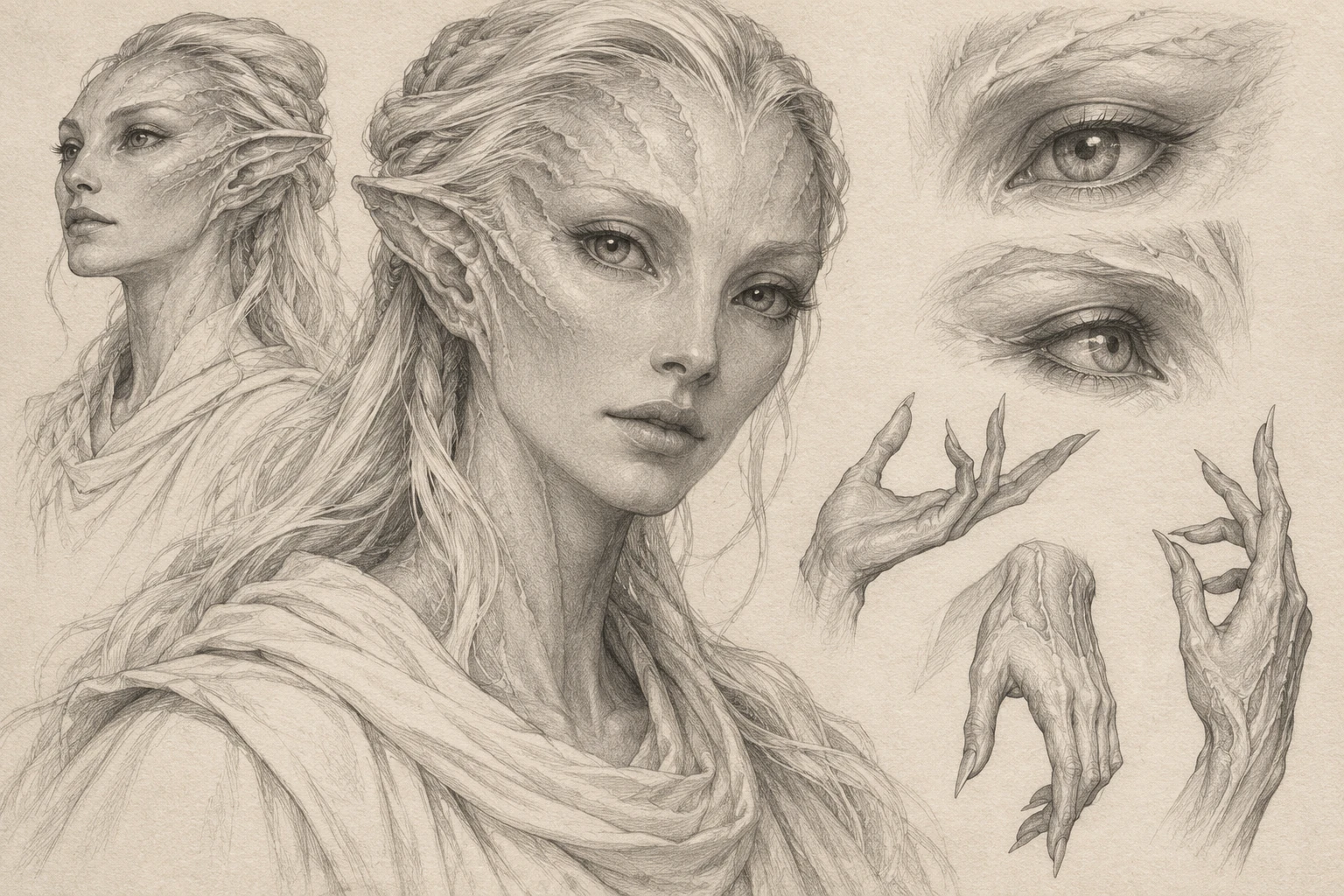
Sael always notices the windows. Ilyr notices the light falling through them. Neris notices whether I have eaten. Those are the first distinctions I made between the people who kept returning, long before I began associating them with star systems or trying to understand their places in a larger story. Familiarity did not arrive as a revelation. It arrived as habits, repeated enough times that I found myself expecting them.
Sael is the one I remember from childhood, although recognition and chronology are not simple things in these accounts. She waits before answering. Sometimes the pause irritates me. I fill it with possibilities and then become angry at answers she has not given. She seems to know this without rewarding it. When I finally ask the question plainly, her expression changes. I have come to recognize that change as relief rather than approval.
Ilyr is harder to draw. His face has broad planes that look blunt in pencil unless I soften them, and softening them loses something essential. There is a deep-blue quality to his skin, with a faint light near the temples that becomes stronger when he attends closely. He communicates in arrangements. A question about distance may arrive as several objects taking their places in a room. I often understand the relationship before I understand what the objects represent.
The first time I met him, I thought he was indifferent to me. He stood apart while Sael and I struggled with an explanation. Later he changed the light in the room because it was giving me a headache. He had noticed before I said anything. It was a practical kindness, performed without asking me to acknowledge it. Since then I have been more cautious about interpreting an unfamiliar face through expectations it did not grow up learning to meet.
Neris laughs, although I am uncertain whether the sound is entirely natural to her or something she learned for my benefit. Her skin is copper-brown and her dark hair is usually braided close to her head. I have never seen her arrive without looking first at the floor, as if checking its condition. She once explained a complicated idea using a cup, a book, and my house keys. When I began writing it down, she rearranged them and made the explanation better.
They disagree. Neris once interrupted Sael so quickly that the atmosphere changed before I understood why. Ilyr remained silent. I could feel their attention passing between them, but very little of its content reached me. I was hurt by the exclusion and said so. Neris apologized. Sael explained that being present did not make me responsible for everything being discussed. I understood the point and disliked it anyway. Familiar relationships have room for that kind of contradiction.
I have associated Sael with the Pleiades, Ilyr with Arcturian traditions, and Neris with a Sirian current within the story. Those names are working translations. I do not possess coordinates, travel records, or independent confirmation. They organize my notebooks; they do not turn them into an astronomical catalogue. When I forget that distinction, I begin writing profiles instead of remembering people. The profiles become tidy. The encounters never are.
One evening I asked whether they had ordinary days. Neris gave me an impression of repairing something that refused to remain repaired. Ilyr offered the sensation of waiting for a colleague who was late. Sael showed me a shore after rain. I felt, briefly, that I had asked a rude question. I had been treating their lives as if they existed only when they touched mine. The realization was uncomfortable and necessary. I do not know them nearly as well as I sometimes imply.
These pages are an attempt to keep the small observations alongside the extraordinary ones. A braid coming loose. A sleeve folded back. A hesitation before a difficult answer. I want a reader to be able to see the uncertainty around them. I also want to remember that wonder can become another way of refusing to look closely. Whoever these people are, whatever the explanation for my experiences, I owe the memories more attention than a label.
Anna