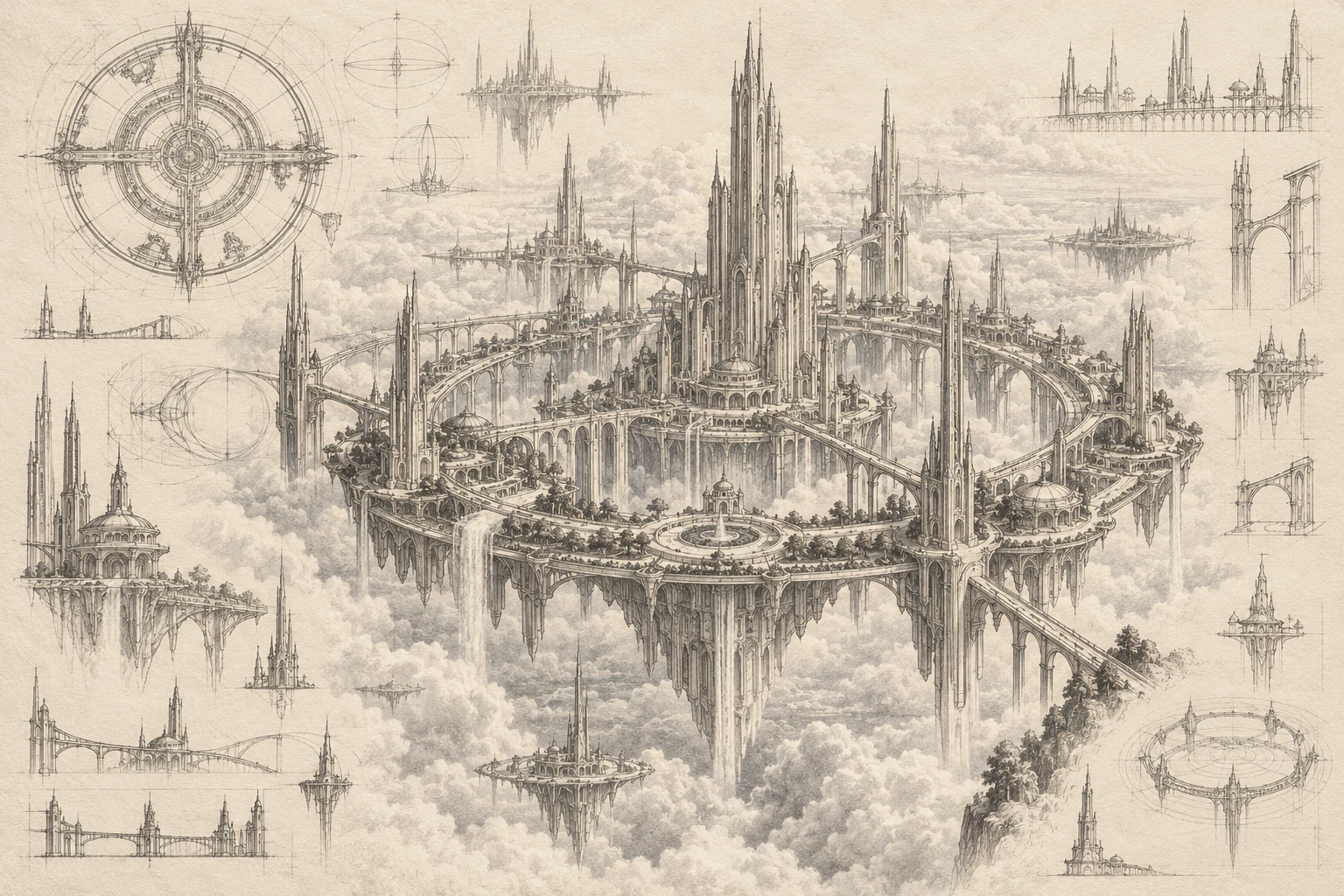
The photograph was small, printed beside a paragraph about a Mesopotamian temple complex. I had been looking for something else entirely. Then I saw the stepped outline and felt an unpleasant certainty that I had drawn it before. I went home, took the oldest notebooks from their box, and spread them across the floor. There it was: a structure rising in shallow stages beneath a ring of lights. My first reaction was triumph. My second was mistrust of the triumph.
A resemblance can feel like recognition without being evidence. I know that sentence because I have written it in the margin of this account three times. I could have seen a similar photograph as a child. Stepped forms are hardly unique. Memory borrows, rearranges, and forgets its sources. Still, the encounter with the image had brought back a particular sensation: warm dust beneath bare feet, a vast bright sky, and someone waiting at the top of a stairway.
That night I dreamed, or remembered, a city beside water. I cannot honestly choose between the words. The buildings were earthy and low except for one rising structure at the center. Beyond it, something much larger hung in the light. It resembled the floating architecture from later encounters, but its edges would not stay clear. The ordinary city below it seemed more definite. I could see people carrying baskets. A dog lay in the narrow shade beside a wall.
Neris stood near me. I asked whether this was the past. She answered with an impression of looking through several translucent sheets. Each held a different image. Where they overlapped, details appeared that belonged to none of them separately. I found the explanation infuriating. I wanted a date and a place. She seemed to be warning me that I was being shown a relationship, or an interpretation, rather than a recoverable historical event.
I have since made separate pages for Sumerian, Egyptian, Greek, and Norse material. On one side I record the historical tradition and the source from which I learned it. On the other I record the associations that arise in the journal. Keeping the columns apart is surprisingly difficult. An image that feels emotionally true exerts pressure on the facts beside it. The more beautiful the association, the more carefully I need to label it.
The Egyptian pages began with the stars and the repeated importance of passage. The Greek ones began with the uneasy relationship between a gift and its consequences. The Norse ones began with a tree linking places that could not be reached by ordinary walking. These are themes within rich human traditions, not hidden diagrams waiting for me to decode them. The faces from my encounters remind me of those ancient images in ways I am still trying to understand. The resemblance is an association, not a replacement for history.
When I asked Sael whether humans had been taught everything by visitors, her response was sharper than I expected. I received the image of hands making something through repeated effort, failing, beginning again, teaching another pair of hands. The meaning was plain enough: do not erase the work of people because an extraordinary explanation is more exciting. I wrote that down immediately. It is the most useful limit any of these encounters has given me.
I returned to the stepped building in my drawing. This time I paid attention to its differences from the photograph. My stairs were too shallow. The proportions were wrong. The setting was invented or uncertain. I added a note beneath it: resemblance observed; origin unknown. It looked disappointingly sober on a page full of impossible things. After a while I began to like the balance. The note gave the drawing room to remain strange without requiring it to settle an argument.
I still feel something when I look at the photograph. I cannot place it. Perhaps it belongs to a forgotten book, perhaps to the strange inner geography these notebooks have accumulated. I am not going to turn that feeling into a claim about who built a monument. Tonight I will draw the stairway again, with the dog in the shade and the baskets in people's hands. Those details seem worth preserving, whichever world they belong to.
Anna